University College of Teacher Education Tyrol at ASEFClassNet19
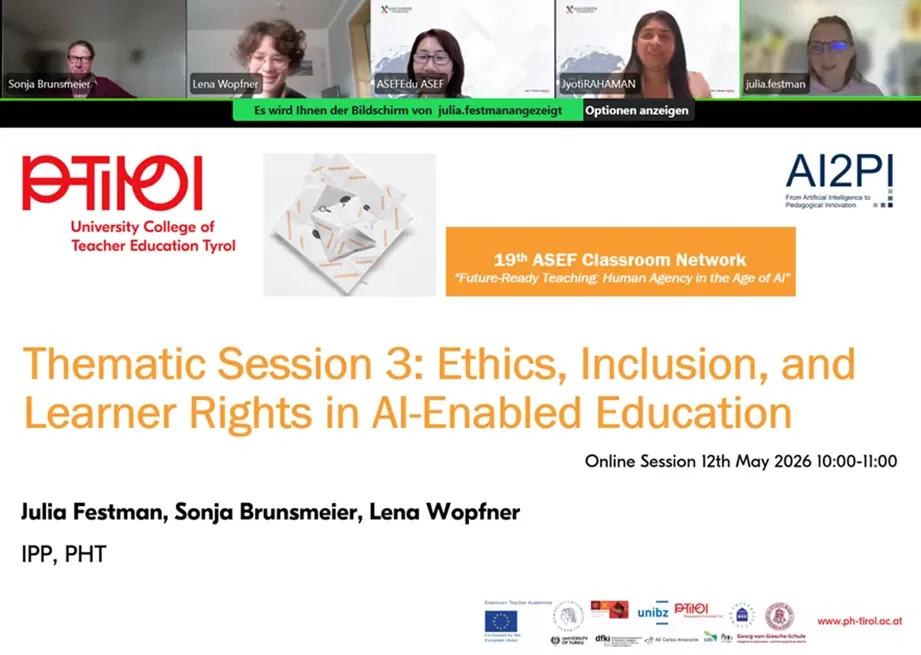
TYROL, May 12, 2026 — Around 100 teachers from Europe and Asia joined the ASEFClassNet19 online session led by researchers from the University College of Teacher Education Tyrol, exploring how AI-enabled education intersects with language diversity, inclusion, and learner rights. Through practical examples and critical discussion, the session highlighted a central challenge for AI in education: ensuring that technological innovation supports participation and equity rather than reinforcing existing linguistic and digital inequalities.
University College of Teacher Education Tyrol at ASEFClassNet19: International Online Session on AI, Language and Inclusion
As part of the Asia-Europe Foundation (ASEF) international education network, Professor Julia Festman, Dr. Sonja Brunsmeier and Ms Lena Wopfner led an interactive online session on the topic of ‘Ethics, Inclusion, and Learner Rights in AI-Enabled Education’ for about 100 teachers from Europe and Asia. The event was part of ASEFClassNet19: Future-Ready Teaching: Human Agency in the Age of AI, which explores how teachers can use AI in a responsible, inclusive and pedagogically reflective manner (see: https://asef.org/projects/19th-asef-classroom-network/).
The international event focused on the challenges posed by linguistic and digital inequality in the classroom. The speakers illustrated and discussed with the participating teachers how, on the one hand, the language of instruction, multilingualism and dialects, and on the other, unequal access to digital technologies and varying levels of proficiency in using AI applications, can affect pupils’ learning opportunities and well-being, as well as their participation and rights. Thereby, they critically examined the opportunities, but also the risks, associated with AI-supported translation and assistance systems – for example, with regard to bias, stereotypical representations or inaccurate information.
The online session also addressed issues of language diversity, digital inequality and participation in AI-supported teaching. Using an example from subject-specific teaching (Home Economics), the speakers demonstrated how language barriers can influence learning processes – for instance, when recipes, task instructions or technical terms are not understood due to academic language, dialect or multilingualism. Critical reflection was also encouraged on how unequal access to digital technologies and varying levels of proficiency in using AI applications can affect pupils’ learning opportunities and well-being.
Another key focus was a critical examination of AI-powered translation systems. Using a traditional regional dish – ‘Schlutzkrapfen’ – as an example, it was demonstrated that AI applications can sometimes present cultural content in a stereotypical manner or generate incorrect information. In connection with this, participants discussed challenges such as bias in AI systems, the dominance of major languages in the digital space, and the question of how linguistic and cultural diversity can be taken into account in AI-supported learning environments.
Drawing on their expertise in language education and language-sensitive teaching methods, the three speakers provided a well-founded and practical demonstration of how teachers can use AI not merely as a technical tool, but in a pedagogically informed way to promote inclusion, equal opportunities and the development of language skills. The international exchange with teachers from different educational contexts made it clear that issues of language, participation and digital equity are key global issues for the future of human-centred AI education.